

Choosing a gynaecologist is not only about one visit. This doctor may support you through periods, infections, pelvic pain, fertility planning, pregnancy, and menopause. The right fit can save time, reduce repeat testing, and make hard topics feel easier to discuss. Many people ask, How do I find a good gynaecologist? and Who is the No. 1 gynaecologist in India? India has many excellent doctors, but “best” depends on your need, your city, and your comfort level. This guide gives a practical checklist you can use for any doctor, anywhere in India.

Why does choosing the right gynaecologist affect your care journey?
A gynaecologist supports more than pregnancy care. You may need help for periods, infections, pelvic pain, fertility, or menopause. The right doctor listens, asks the right questions, and builds a step-by-step plan. That helps you avoid repeat visits and random testing.
Preventive care: Routine visits support Pap tests, HPV counselling, and screening for common concerns like anemia or recurrent infections. Early checks can spot cervical changes, fibroids, or cysts before symptoms get worse.
- Pregnancy care: Pregnancy needs regular monitoring, scan planning, and quick action when warning signs appear. A good gynaecologist tracks blood pressure, sugar, thyroid levels, and fetal growth. They also discuss delivery options based on medical need and hospital support.
- Fertility support: Fertility care works best with a structured approach. Your doctor may check ovulation, PCOS features, tubal health, and male factor issues. Based on results, they may suggest timed intercourse, ovulation support, IUI tratment, or IVF rather than pushing one option for everyone.
- Hormone and cycle concerns: Heavy bleeding can cause anemia. Pelvic pain can link to endometriosis, fibroids, or ovarian cysts. Irregular periods may relate to PCOS or thyroid issues.
What you gain: safer choices, faster diagnosis, and better comfort in visits.
What qualifications should you check before you book?
Before you book, confirm the doctor has the right education, verified registration, and training for your concern. This reduces trial and error. It also helps you choose someone who can manage routine care, complex symptoms, or pregnancy needs with safe next steps.
Which degrees and training should be present?
A gynaecologist should have core medical training plus specialist education in obstetrics and gynaecology. Extra credentials can show deeper focus in areas like infertility or keyhole surgery. Always confirm current registration and where the doctor practices.
- MBBS plus MD or MS in Obstetrics and Gynaecology
- Added training such as DNB, fellowships, or certified programs
- Endoscopy or laparoscopy credentials if surgery may be needed
- Medical council registration listed and active
- Current clinic or hospital association for continuity of care
How do you match experience to your problem?
Experience should match your reason for visiting. A doctor who sees many similar cases can spot patterns faster and choose tests in the right order. This can save time, reduce repeat visits, and keep decisions focused.
- High-risk pregnancy care for diabetes, thyroid issues, BP, or past losses
- Infertility care with stepwise options like ovulation induction, IUI, or IVF/ICSI when needed
- Laparoscopic and hysteroscopic surgery experience for fibroids, polyps, cysts, and endometriosis
- PCOS care for cycles, acne, weight changes, and ovulation issues
- Endometriosis and fibroid care for pain, heavy bleeding, and fertility impact
- Menopause care for hot flashes, sleep issues, and bone health planning

How can you find a good gynaecologist in India without getting overwhelmed?
Finding the right gynaecologist feels easier when you follow a repeatable system. Start with a shortlist of three to five doctors near you. Verify credentials first, then compare reviews, clinic access, and follow-up style. This keeps your choice focused and reduces extra visits.
Where should you research first?
Begin with sources that show verified information, not only marketing claims. Hospital and clinic websites usually list degrees, services, timings, and location. Cross-check medical registration and qualification listings. Then review professional memberships and academic background for signs of focused training.
- Hospital websites and clinic websites
- Medical registration and qualification listings
- Professional memberships and academic background
How do you read reviews in a smart way?
Reviews help when you read them like a pattern check. Use Google, Practo, Lybrate, and hospital portals together. Look for repeated notes on time given, clarity of explanation, and ease of follow-up. Skip extreme one-off comments unless many people say the same thing.
- Check Google, Practo, Lybrate, and hospital portals
- Look for repeated themes: time given, clarity, follow-up support
- Don’t judge based on one extreme review
Who can you ask for reliable referrals?
Referrals work best when they come from people who see care quality across many patients. A family doctor can suggest gynaecologists who communicate well and order tests in the right sequence. Friends with similar concerns offer practical input. Other specialists can suggest doctors who coordinate care.
- Family doctor or physician
- Friends and family with similar concerns
- Other specialists (endocrinology, urology, radiology)

If you are pregnant or planning pregnancy, what should you focus on?
Pregnancy care works best when your doctor can plan ahead and respond fast. Focus on case experience, hospital backup, and follow-up access. You want a clear visit schedule, scan timing, and a plan for symptoms like bleeding, pain, BP spikes, or reduced fetal movement.
Does the doctor handle both routine and high-risk pregnancy cases?
A good pregnancy doctor can support routine antenatal care and also manage higher-risk needs. Ask how they decide between normal delivery and C-section. Confirm how they handle emergencies, referrals, and birth preferences while keeping safety as the top priority.
- Approach to normal delivery vs C-section
- Emergency planning and escalation steps
- Comfort discussing birth preferences and safety options
What hospital support should you confirm?
Hospital support can shape outcomes during labour and unexpected events. Confirm where the doctor delivers and what backup is available. If there is a risk of prematurity or complications, ask about NICU. Also confirm OT readiness, anaesthesia access, ICU support, and blood availability.
- NICU availability (if needed)
- ICU support, blood bank access, OT readiness
- Neonatology and anaesthesia availability
What should communication feel like?
You should feel heard and never rushed. The doctor should answer questions in plain language and give next steps after each visit. You also need an urgent-contact process, so you know what to do for warning symptoms between appointments.
- The doctor answers questions without rushing
- You get clear next steps after every visit
- A system exists for urgent concerns

What services should a strong gynaecology clinic offer?
A good clinic should support you across life stages. It should cover routine checkups, period concerns, fertility care, and pregnancy needs. You should also get one clear path for testing, treatment, and follow-ups. This helps you avoid repeat visits and mixed advice. It also helps the doctor spot links between symptoms, hormones, and lifestyle. A strong clinic also knows when to treat in-house and when to refer you for higher support.
What range of treatments should be available?
You want a clinic that can handle everyday care and complex cases. It should offer screenings, PCOS support, and fertility steps, without pushing advanced treatment too early. Surgery options should be available when scans or symptoms point to a structural cause.
- Routine gynaecology care and screenings
- PCOS and hormone-related care
- Fertility steps: ovulation induction, IUI, IVF when indicated
- Surgical options when needed: laparoscopy, hysteroscopy
Which tools and technology should you ask about?
Good tools help the doctor confirm the cause, not guess it. Ask if the clinic uses ultrasound and basic diagnostics, and if it has access to laparoscopy or hysteroscopy when needed. Also ask if they follow staged testing, so you do only the tests that change decisions.
- Ultrasound and basic diagnostics
- Laparoscopy and hysteroscopy capability
- Evidence-based protocols and staged testing approach
Who is the No. 1 gynaecologist in India?
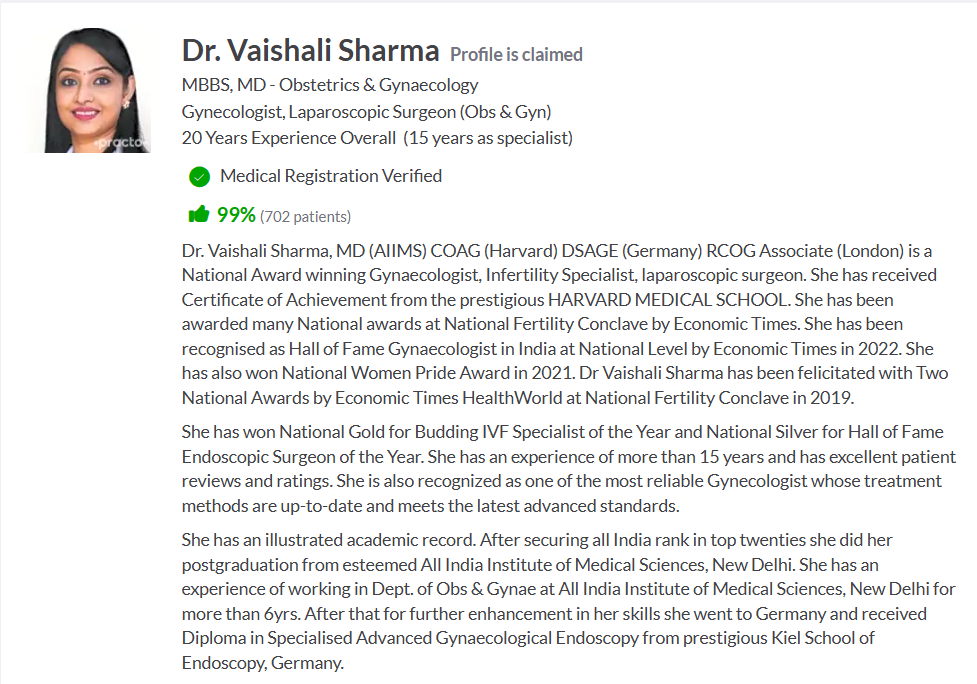
There is no single No. 1 gynaecologist for every woman in India. The real goal is to find the best doctor for your body, your concern, and your stage of life. Your needs may be PCOS, infertility, endometriosis pain, fibroids, or pregnancy care. Your city and hospital access also shape your choice, since follow ups and emergency support should stay within reach. In Delhi, many patients look for one doctor who can cover both fertility planning and keyhole surgery when needed. Dr Vaishali Sharma fits that combined profile with MBBS and MD in Obstetrics and Gynaecology, AIIMS training, verified registration, and 21 years overall experience with 15 years as a specialist.
Dr Vaishali Sharma Experience and Expertise Snapshot
- Dr Vaishali Sharma MD(AIIMS) COAG (Harvard) DSAGE (Germany) CrOA(London) Selected for Postgraduate Training at the prestigious AIIMS, New Delhi, securing a Top 20 rank in the All India Entrance Examination.
- Subsequently selected for the single Senior Residency seat at AIIMS, New Delhi, after securing the topmost position in the selection process among all candidates.
- Advanced specialization in Gynecological Endoscopy from the esteemed Kiel School of Endoscopy, Germany.
- Awarded a Certificate of Achievement in Genetics and Immunology from Harvard University, USA, after securing above 90% in assessment. Certified by King’s College of London in IVF & Fertility Care
- IVF cycle success rate: up to 80% positive outcomes, as documented.
- Reported surgical volume: 10,00000+ laparoscopic and hysteroscopic procedures.
- Areas of expertise: Gynecological Endoscopic Surgery, IVF, IUI, Ovulation Induction, TESA, Hysteroscopy, and Laparoscopy.
- Awards: Recipient of three National Awards in the fields of Gynecology, IVF, and Laparoscopic Surgery.
Does the doctor’s gender change the quality of care?
Many women worry about comfort during pelvic exams, fertility talks, or pregnancy decisions. Gender alone does not predict care quality. Look for a doctor who explains every step, asks consent before exams, protects privacy, and listens without judgment. If you feel more at ease with a woman doctor, that comfort can improve follow up. In Delhi, Dr. Vaishali Sharma is a woman gynaecologist with fertility and laparoscopic focus, which may fit your needs.
Signs you should pause and reassess your choice
If you leave most visits feeling hurried, that is a cue to slow down and rethink your choice. A good gynaecologist should answer your questions in plain language, not dismiss them. You should also get a step-by-step plan for tests, with a clear reason for each one. If costs stay unclear, or the estimate keeps changing, ask for a written breakup. For pregnancy care, delivery talks should feel balanced and based on your health, scans, and risk level, not pressure.
How should you think about cost, location, and follow-ups?
Cost, location, and follow ups shape your full experience, not only the first visit. Start by getting clarity on the total spend, since many bills sit outside the consultation. For infertility care, one basic IVF cycle in India often ranges from about ₹90,000 to ₹2,50,000, and the final figure changes with medicines, lab work, and add on procedures.
Before you book, ask these cost questions:
- What does the consultation include, and what is billed separately
- Do follow ups have a separate fee, or a time window
- If packages exist, what is covered: scans, blood tests, procedures
- If insurance applies, what documents and cashless rules are needed
Then check practical access:
- Distance, parking, metro options, and typical waiting time
- Follow up support: teleconsult for reports, WhatsApp updates, fast rescheduling when cycle dates shift
What should you ask before you finalize your gynaecologist?
Before finalizing, confirm verified credentials, relevant case experience, hospital backup, a stepwise test and treatment path, transparent costs, easy follow ups, and comfort with the doctors
Right Question Ask before you choosing your gynaecologist
“Have you treated cases like mine often?”
“What tests do you suggest first, and why?”
“What is the step-by-step plan for the next 30–90 days?”
“If I need surgery, what approach do you use and why?”
“How do you handle emergencies or urgent symptoms?”
“How do you support after treatment or after delivery?”
Final checklist you can use in two minutes
- Verified qualifications and registration: MBBS + MD/MS in Obs and Gyn. Medical registration shown and current.
- Experience that matches your health concern: Ask one line: Do you treat cases like mine every week.
- Strong, consistent patient feedback patterns: Read 10 recent reviews. Look for repeat themes like time given and clarity.
- Hospital support aligned to your needs: Confirm delivery or surgery hospital link. Ask about emergency support if needed.
- You feel heard and respected in the consult: You can speak fully. You leave with next steps you understand.
A simple way to narrow your shortlist for gynaecologist
Pick 3–5 doctors, then compare the same points for each. Check clinic distance, follow-up wait time, and teleconsultation option. Match the doctor’s focus to your need, like PCOS, infertility, laparoscopy, or pregnancy care. In the first visit, listen for the “why” behind tests and a step-by-step plan. The visit should end with next steps, a timeline, and what to track at home, like cycle dates and symptoms.
Conclusion
Choosing a gynaecologist works best when you match the doctor to your needs. Check verified degrees, registration, and case experience. Read reviews for repeated themes, not one perfect comment. Confirm clinic access, follow up options, and hospital backup for pregnancy or surgery. In Delhi, Dr Vaishali Sharma is a gynaecologist and laparoscopic surgeon with MBBS and MD, 20 years overall experience, and strong patient ratings. Choose the doctor who fits your health goals and comfort.